
Engine decarbonisation by blasting
Among its services, Service Pinjušić offers engine decarbonisation - by blasting with walnut shell granulate.
Send a query
SYMPTOMS of soot and oil deposit build-up:
- rough running at cold start
- light smoke from the exhaust
- misfiring on an individual cylinder
- increased fuel consumption
- loss of power and limp mode
- increased NOx emissions, failed emissions test
- black smoke under heavier load
- clogged DPF
Engines with direct fuel injection, whether modern diesel (TDI, HDI, CDI, Tdci, Jtd, Multijet) or petrol (GDI), during use are prone to the formation of carbon deposits, i.e. deposits of soot, burnt engine oil and fuel.
These deposits settle on the walls of the intake manifold around the intake valves and in the intake ports of the cylinder head. This reduces the airflow into the cylinders, and irregular swirl (turbulence) also appears, characterised by air particles gaining additional speed at medium velocity, which may run counter to the direction of flow.
The video is played via YouTube. When you load it, Google may set its own cookies.
To remove these deposits, engine decarbonisation needs to be carried out.
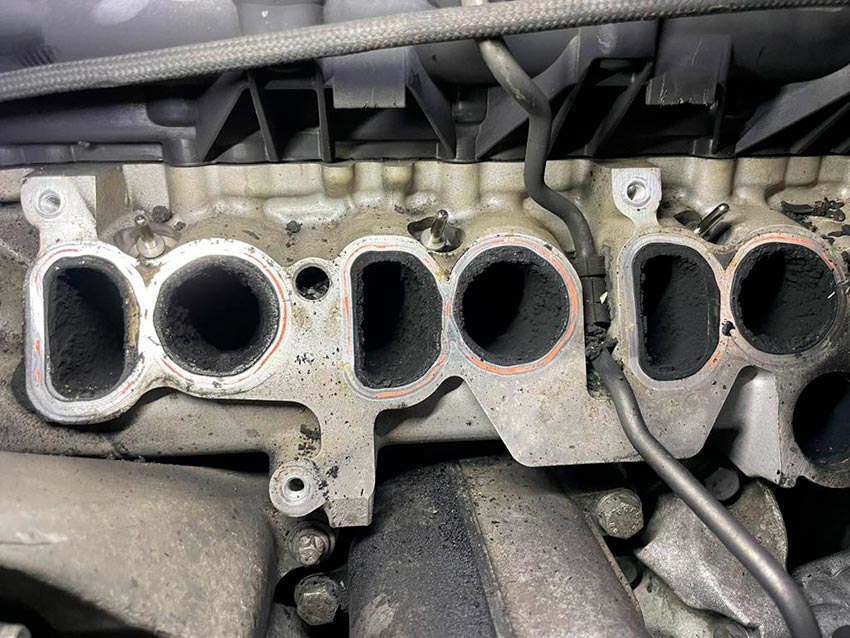
picture BEFORE engine decarbonisation
picture AFTER engine decarbonisation
Engine decarbonisation - removal of soot deposits
Blasting with an organic abrasive medium (walnut shell granulate) makes it possible to remove soot deposits from the walls of the intake valves and cylinder head ports.
Cleaning is carried out with the valves closed, while the medium and soot are removed simultaneously by vacuum.
With this method there is no risk of damage to the engine and units such as turbochargers or the DPF (soot filters).
Before cleaning, the engine's intake manifold must be removed; it is also cleaned in an ultrasonic bath.
ADVANTAGES after engine decarbonisation:
- quieter and smoother engine running
- reduced fuel consumption
- better emissions test result
- better throttle response
- more engine power


picture BEFORE engine decarbonisation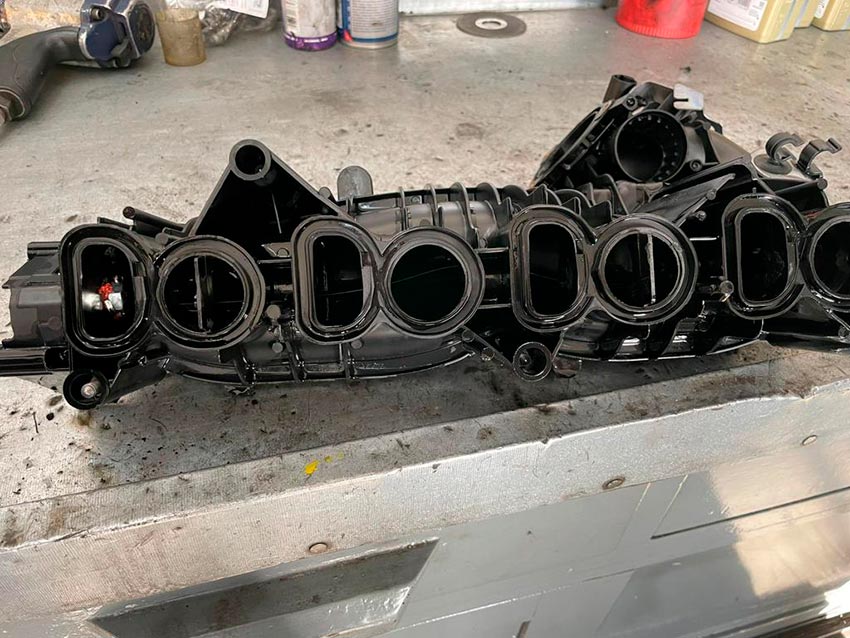
picture AFTER engine decarbonisation
To arrange ENGINE DECARBONISATION send us an enquiry, call +385 1 2995 244 or contact us by e-mail: servis@pinjusic.hr
Send an enquiry


